Figure Analysis (macOS)🪶
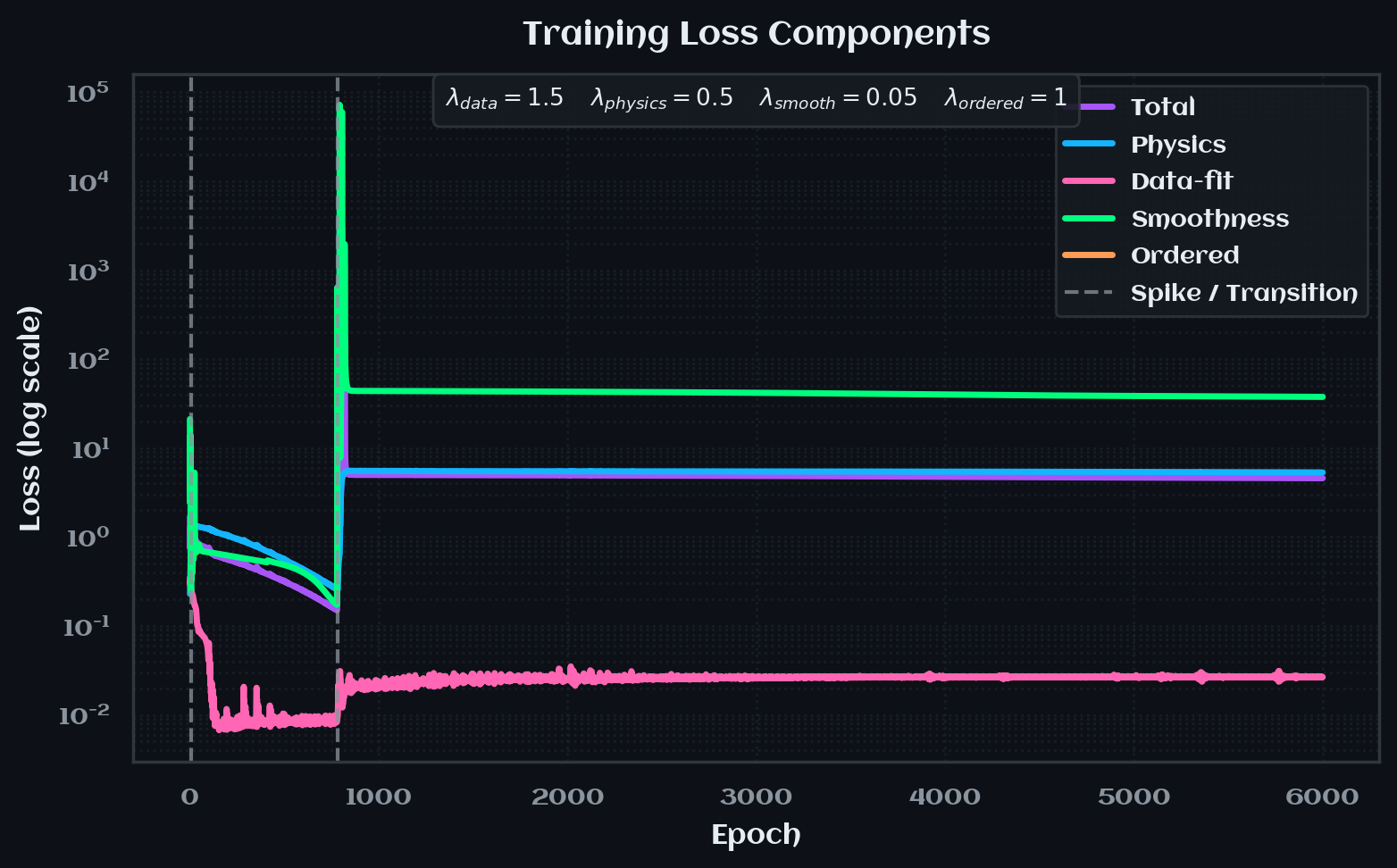
Figures 1 a-c - Training Curves
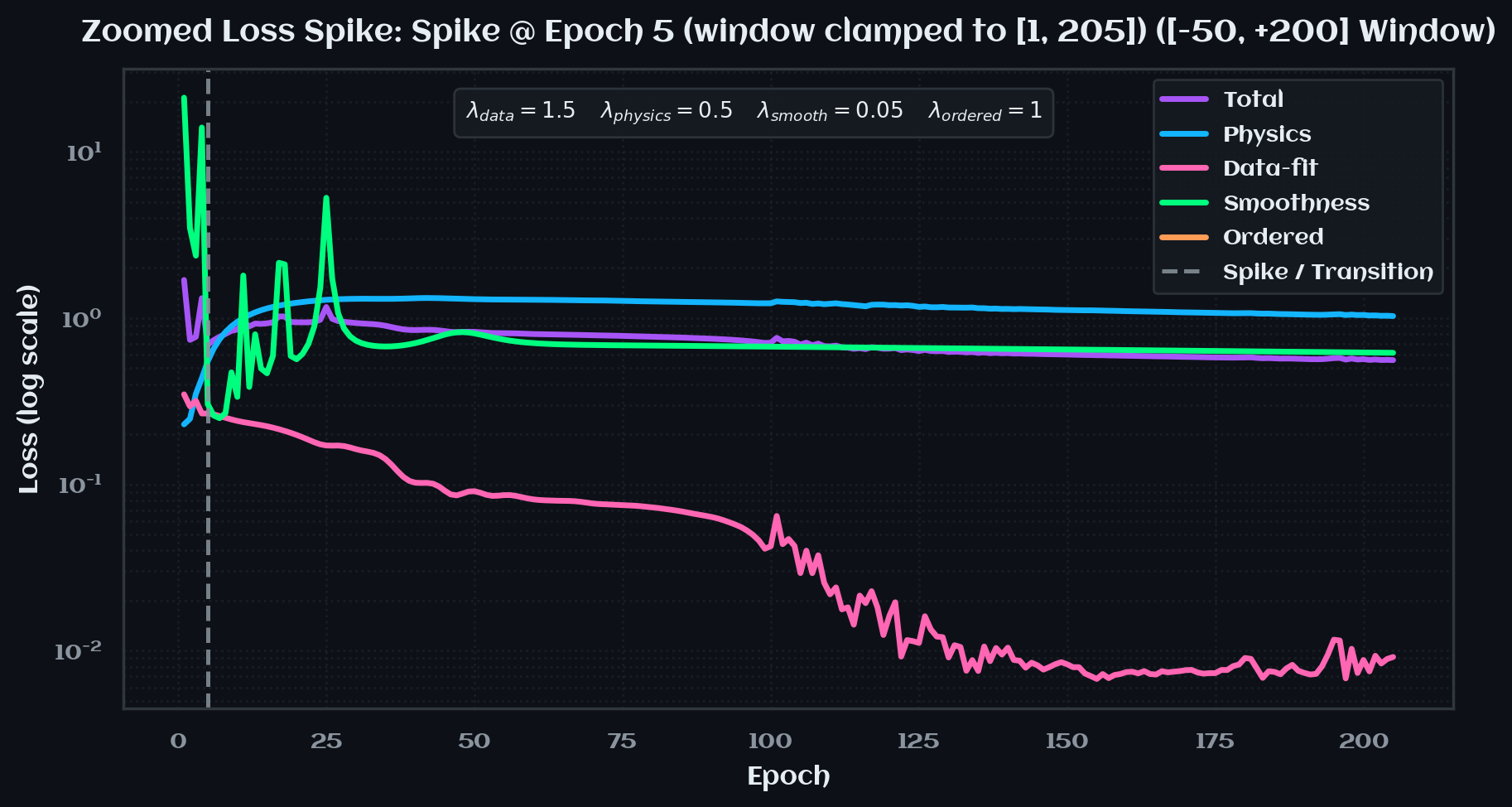
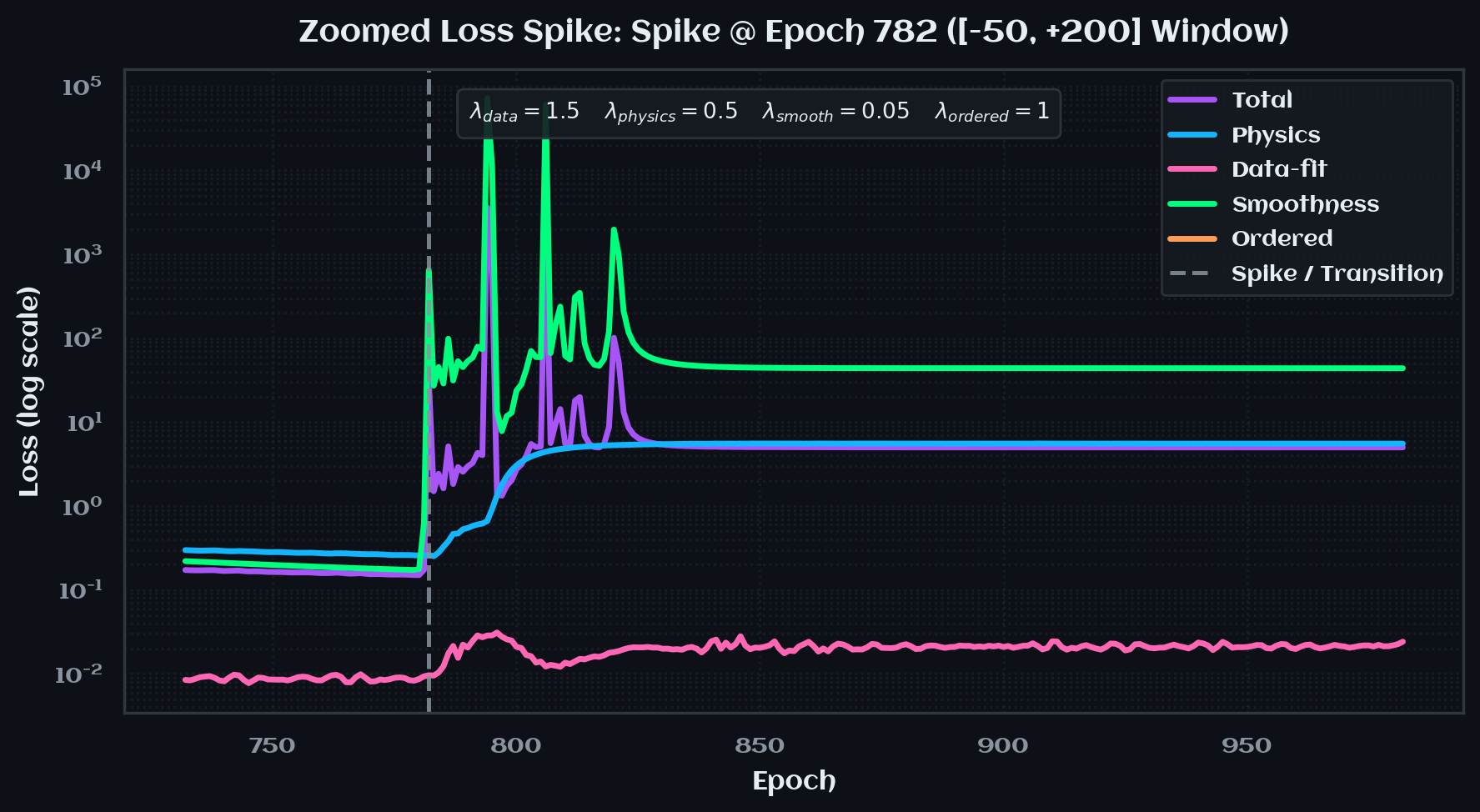
| Figure 1b - Spike 1 | Figure 1c - Spike 2 |
|---|---|
 |
 |
Take-Home Message
The optimizer exhibits two distinct regime transitions before settling on a stable plateau.
🔑 Key Insights
- Spike 1 - Epoch 5: Expected transient while the network adjusts from random initial weights.
- Spike 2 - Epoch 782: Discovery of a higher-curvature potential: smoothness and total loss spike, physics and data terms rise only moderately.
❌ Failure Modes
| Verdict | Failure Mode | Description | Explanation |
|---|---|---|---|
| ❌ | High final loss | Optimizer stalls in a local minimum. Heavily driven by \(\lambda_\text{smooth}\mathcal{L}_\text{smooth} \gg \lambda_\text{data}\mathcal{L}_\text{data}\). |
Total loss remains greater than 1e-1 at epoch 6000. 📝 A high wieghted total loss is not necesarilly a failure if the physical residue \(\lambda_\text{TISE}\mathcal{L}_\text{TISE}\) and data loss \(\lambda_\text{data}\mathcal{L}_\text{data}\) are near convergence (\(10^{-3}\) to \(10^{-4}\)). |
| ✔️ | Oscillation avoided | Unbalanced loss weights can cause loss terms to oscillate. | Curves converge monotonically shortly after spike 2 (epoch 782). |
| ❌ | Physics collapse | Data loss decreases, while TISE residual increases. | Indicates operator inconsistency. |
| ❌ | Over-regularization | Smoothness term dominates, spectrum becomes innacurate. | Loss curves all begin to plateau after ~epoch 850 with \(\lambda_\text{smooth}\mathcal{L}_\text{smooth}\) taking on values much higher than the other loss terms. |
Sanity Checks🪶
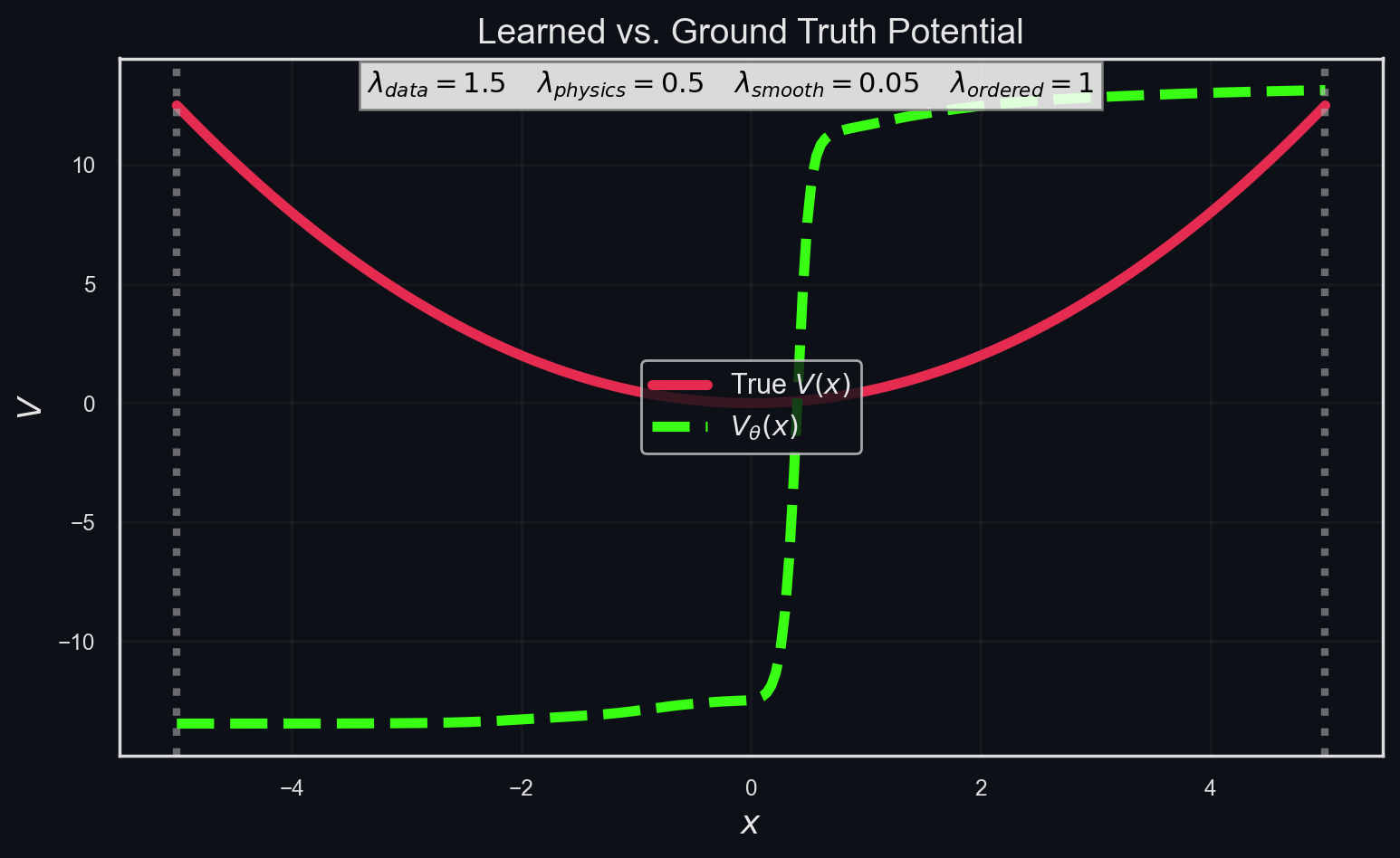
Figure 2 - \(V_\theta\) vs. \(V(x)\)
Take-Home Message
The learned potential \(V_\theta(x)\) (sigmoidal) differs markedly from the harmonic ground truth \(V(x)=\tfrac12 x^2\).
🔑 Key Insights
- Central regions of the learned eigenfunctions (Fig. 3) and densities (Fig. 5) match the ground truth far better than the tails.
- The model learns only the portion of \(H_\theta\) required to reproduce high-probability regions, :ember: exposing the inverse problem's under-determinism.
❌ Failure Modes
| Verdict | Failure Mode | Description | Explanation |
|---|---|---|---|
| ❌ | Gemoetric mismatch | Learned \(V_\theta\) shape incompatible with true quadratic. | Central well too narrow; tails saturate at $V_\theta \approx \pm 12 $. |
| ❌ | Boundary under-constraint | Sparse data at \(x \in (-\infty, -4.5] \cup [4.5, \infty)\) allows the potential to drift. | Grey dashed domain limits show no training points beyond. |
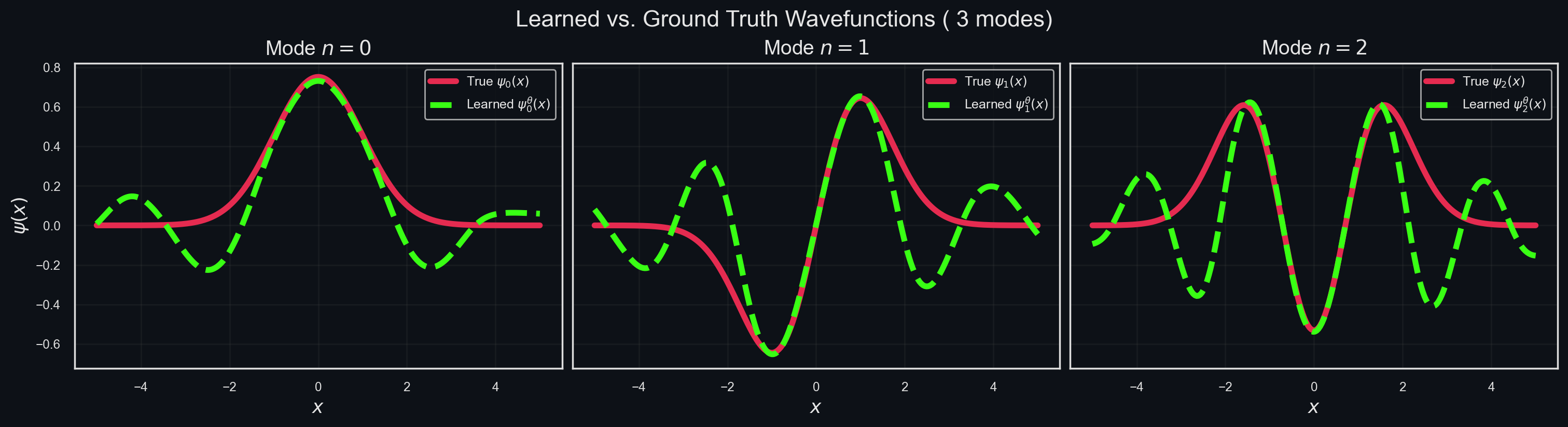
Figure 3 – \(\{\psi_n^\theta\}\) vs. \(\{\psi_n\}\)
Take-Home Message
Learned eigenfunctions \(\psi_n^\theta(x)\) capture the nodal pattern but diverge in low-amplitude tail regions.
🔑 Key Insights
- Phase matching - Correct nodal count confirms energy ordering.
- Central accuracy - Highest fidelity occurs where \(|\psi_n|^2\) is largest.
- Tail divergence - For \(x \in (-4.5, -2] \cup [2, 4.5)\), the learned curves overshoot, reflecting data scarcity.
❌ Failure Modes
| Verdict | Failure Mode | Description | Explanation |
|---|---|---|---|
| ❌ | Nodal mis-count | Extra nodes appear beyond \(x \approx \pm 3\)) | Indicates spectral leakage. |
| ✔️ | Sign / parity flip | Unaligned solutions may invert parity | Sign aligned; parity matches ground truth. |
| ❌ | Spurious oscillations | High-frequency ripples in tails from weak \(V_\theta\) smoothness. | Visible beyond \(x\approx \pm 4\). |
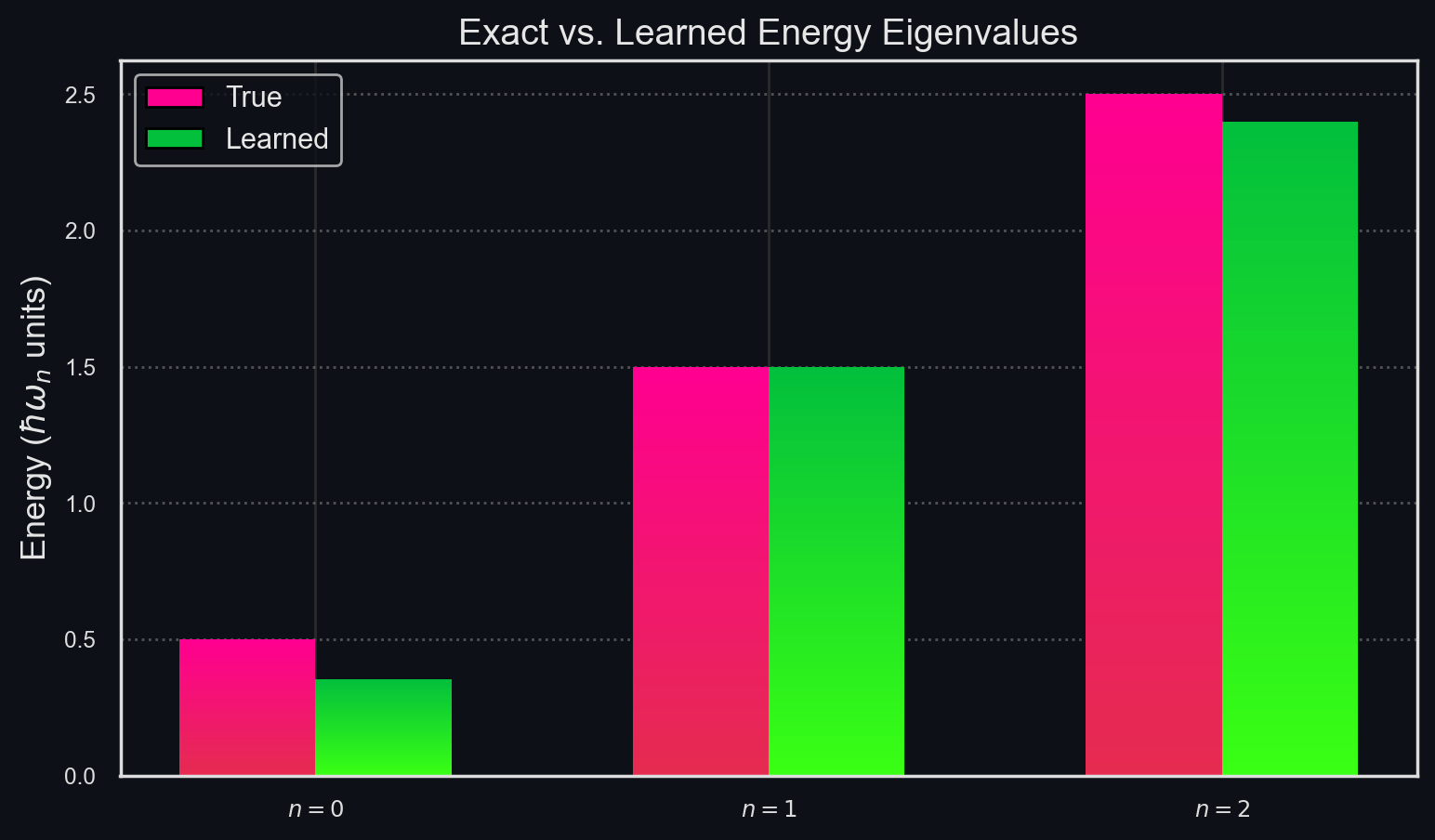
Figure 4 – \(\{E_n^\theta\}\) vs. \(\{E_n\}\)
Take-Home Message
Learned energies \(E_n^\theta\) follow the harmonic spectrum \(E_n=n+\tfrac12\) and match observations within 5 %.
🔑 Key Insights
- Correct ordering suggests \(\mathcal{L}_\text{order}\) is effective.
- Spectrum remains stable despite 2z% Gaussian noise in training data.
❌ Failure Modes
| Verdict | Failure Mode | Description | Explanation |
|---|---|---|---|
| ❌ | Spectral fit, wrong operator | Energies match, but \(V_\theta\) deviates (see Fig. 2) |
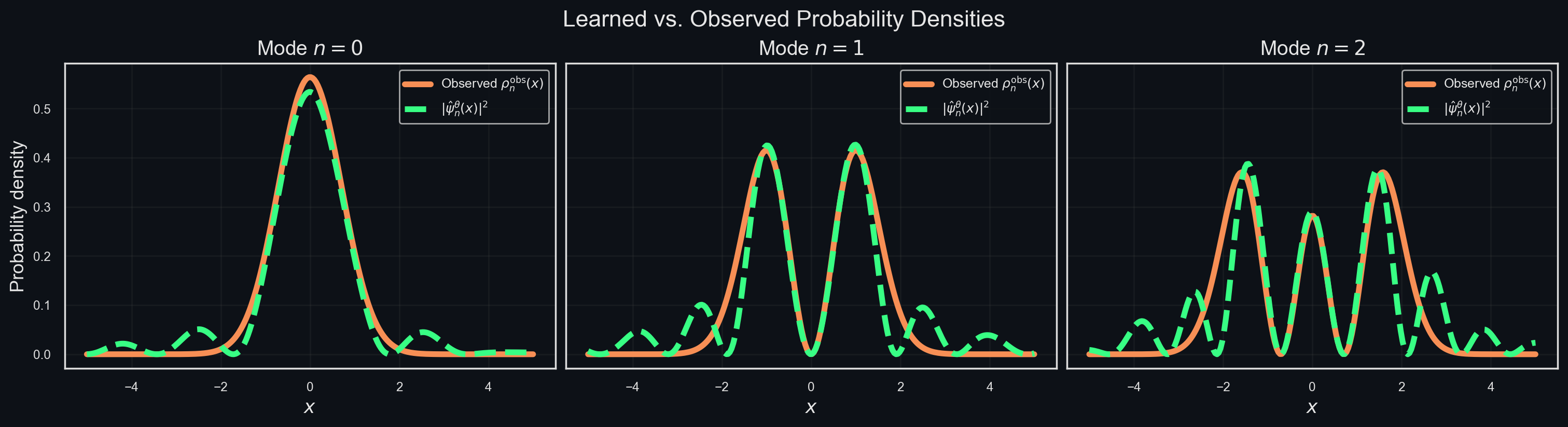
Figure 5 - \(\{|\psi_n^\theta|^2\}\) vs.\(\{\rho_n^\text{observed}\}\)
Take-Home Message
Learned densities, \(\rho_n^\theta = |\psi_n^\theta|^2\) agree with 2%-noise observations.
🔑 Key Insights
- Noise filtering - PINN acts as a physics-informed smoother.
- Data dominance - Good density fit persists even with incorrect potential (Fig. 2), confirming \(\mathcal{L}_\text{data}\) is easy to minimize.
❌ Failure Modes
| Verdict | Failure Mode | Description | Explanation |
|---|---|---|---|
| ✔️ | Peak flattening | Excessive \(\lambda_\text{smooth}\) can lower peaks | Peaks are preserved \(\Rightarrow\) smoothing is well-tuned. |
| ✔️ | Mode merging | Energy mis-ordering can collapse multiple states onto one density. |
POD Analysis🪶
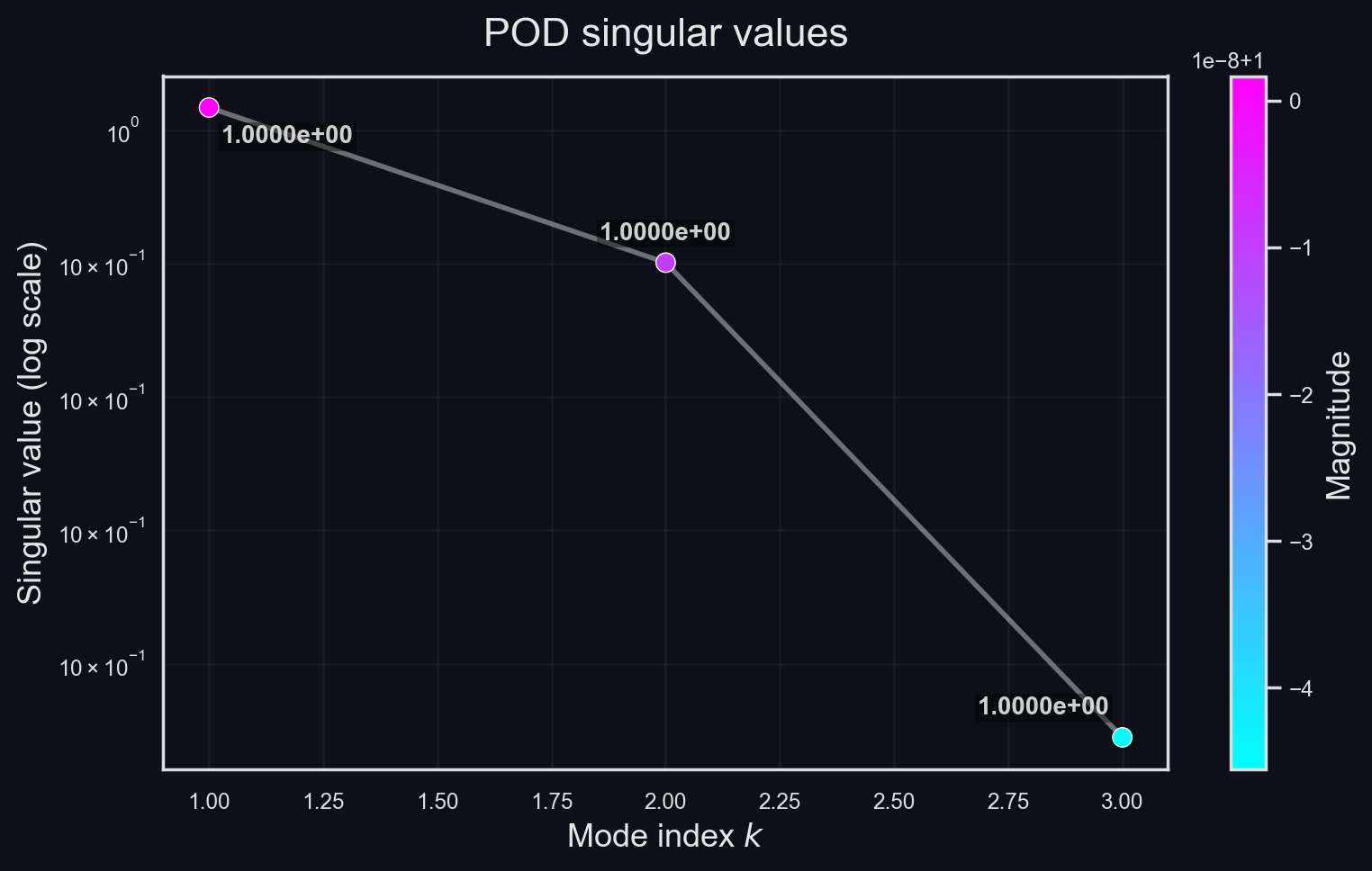
Figure 6 - POD Singular Values
Take-Home Message
Singular values from the POD of the learned wavefunction matrix decrease (log scale) from \(\approx 1\).
🔑 Key Insights
- Rank efficiency - Rapid two-decade decay indicates a low-dimensional basis.
- Basis conditioning - Separation between \(\sigma_0\), \(\sigma_1\), and \(\sigma_2\) quantifies how much "physics" each node carries.
❌ Failure Modes
| Verdict | Failure Mode | Description | Explanation |
|---|---|---|---|
| ❌ | Flat spectrum | All \(\sigma_i\) nearly equal \(\Rightarrow\) modes are independent, but unphysical. | Noise-dominated snapshots. or over parameterization.** The PINN is outputting random high-frequency noise or unconstrained oscillations rather than smooth quantum states. |
| ❌ | Slow decay | \(\tfrac{\sigma_{2}}{\sigma_{0}} \geq 0.3 \Rightarrow\) redundant or correlated modes. | Underfitting or aliasing in learned wavefunctions. The PINN is struggling to resolve sharp potential barriers causing energy to spread across many modes rather than capturing it in a single eigenstate. |
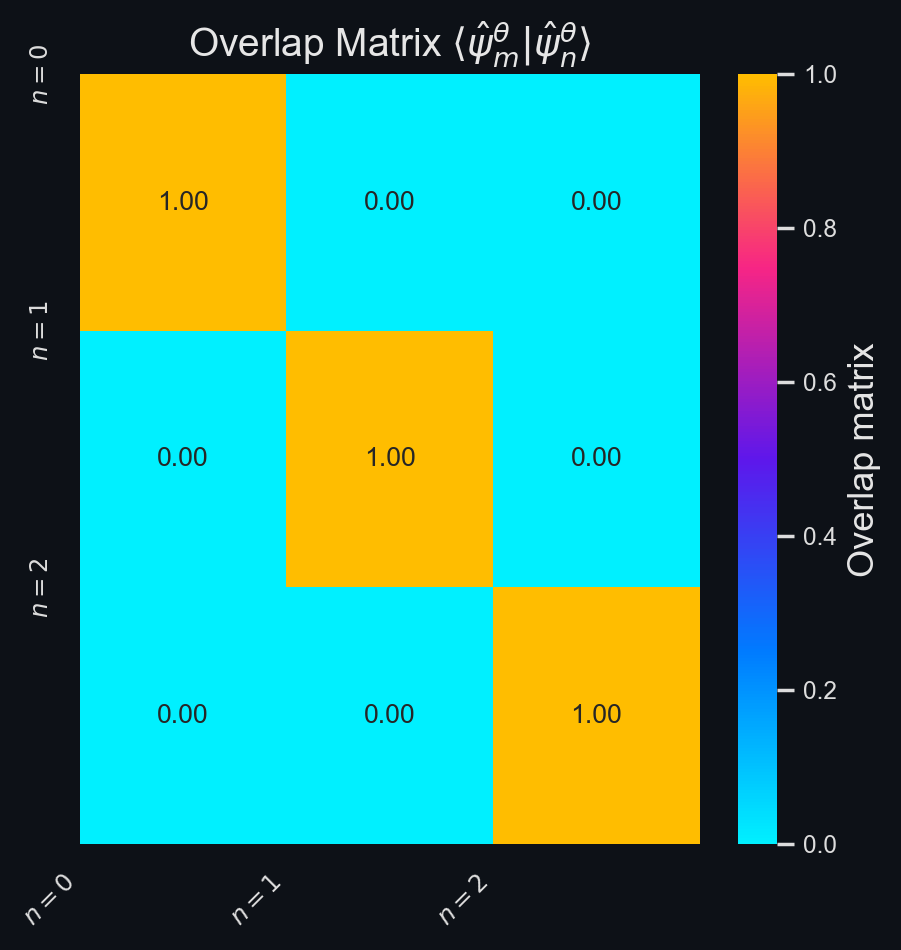
Figure 7 – Mutual overlap heatmap (learned eigenfunctions)
Take-Home Message
Mutual inner product matrix $\langle \hat{\psi}_m^\theta | \hat{\psi}_n^\theta \rangle $ forms an exact identity matrix.
🔑 Key Insights
- Strict mutual orthogonality: - Diagonals are identically \(1.00\) and all off-diagonal entries are \(0.00\).
- Hermetian Basis Property: - Learned eigenfunctions constitute a numericall orthonormal spatial set.
❌ Failure Modes
| Verdict | Failure Mode | Description | Explanation |
|---|---|---|---|
| ✔️ | Non-orthogonality | Off-diagonal entries exceed \(0.10\). | Here, max off-diagonal is \(\ge 0.00\) confirming orthonormal learned state representation. |
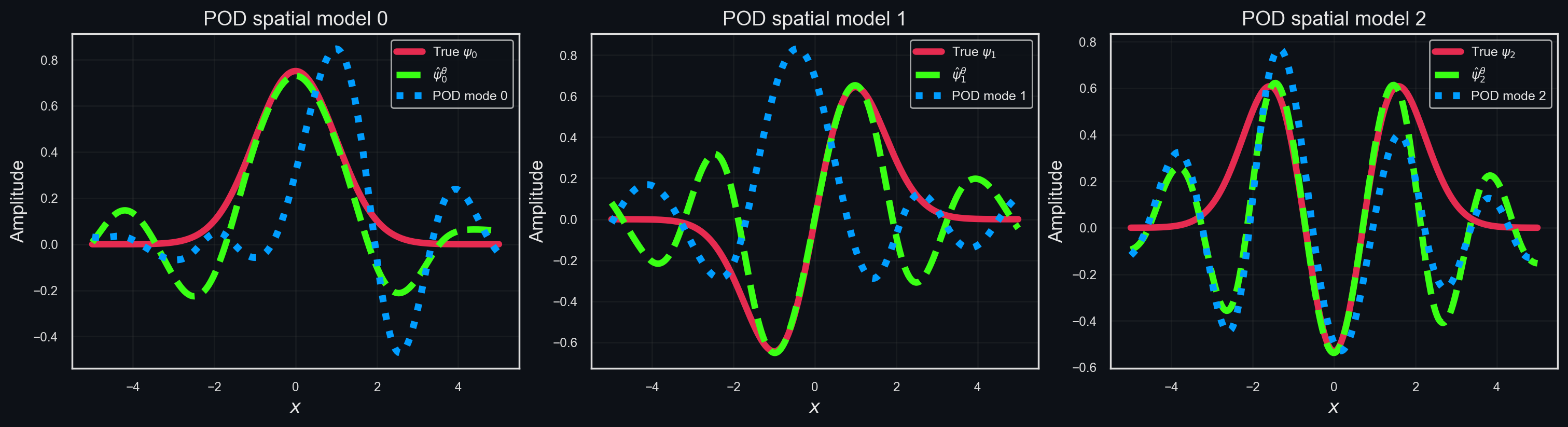
Figure 8 - \(\{u_n\}\) vs. \(\{\hat{\psi}_n^\theta\}\) vs. \(\{\hat{\psi}_n\}\)
- Change \(u_k\) in title and axis labels to \(\sigma_k\)
Take-Home Message
Spatial mode mixing results in deviation of POD spatial modes \(\mathbf{\sigma}_k\) from physical eigenfunctiona.
🔑 Key Insights
- Spatial shift: POD mode \(\sigma_0(x)\) is shifted horizontally relativr to symmetric ground truth \(\psi_0(x)\).
- Asymmetric amplitude: POD mode \(\sigma_1(x)\) exhibits assymmetric peak/trough amplitudes (\(-0.8\) vs. \(+0.45\)).
- Mixed coordinate frame: SVD spatial modes represent linear combinations of learned states rather than pure eigenstates.
❌ Failure Modes
| Verdict | Failure Mode | Description | Explanation |
|---|---|---|---|
| ❌ | Mode mixing | POD modes fail to align with ground truth eigenfunctions. | Significant spatial distortion and asymmetry in \(\sigma_0\) and \(\sigma_1\) POD modes. |
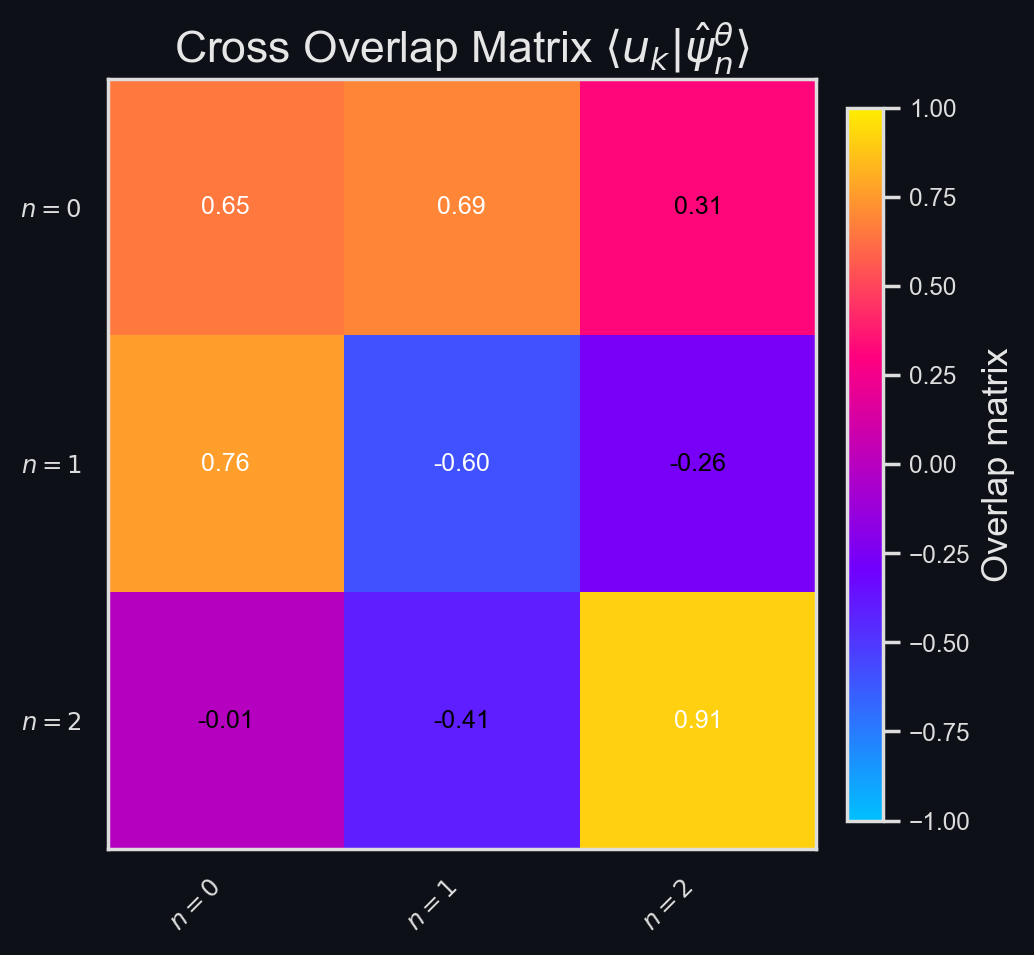
Figure 9 - Cross-overlap heatmap (POD modes vs. learned eigenfunctions)
- Choose different color scale for more intuitive visualization
- Change \(u_k\) in title and axis labels to \(\sigma_k\)
Take-Home Message
Cross-projections \(\langle \sigma_k | \hat{\psi}_n^\theta \rangle\) reveal strong non-diagonal coupling between POD modes and learned wavefunctions.
🔑 Key Insights
-
Rotated basis: Ideal result is \(\pm\) identity; here large off-diagonals show mis-alignment.
- Primary projections: \(\langle \sigma_0 | \hat{\psi}_0^\theta \rangle = 0.88\), \(\langle \sigma_1 | \hat{\psi}_1^\theta \rangle = 0.87\), and \(\langle \sigma_2 | \hat{\psi}_2^\theta \rangle = 0.98\).
-
Off-Diagonal Cross Talk: Significant off-diagonal components: \(\langle \sigma_0 | \hat{\psi}_1^\theta \rangle = 0.46\), and \(\langle \sigma_1 | \hat{\psi}_0^\theta \rangle = -0.47\), and \(\langle \sigma_2 | \hat{\psi}_1^\theta \rangle = -0.20\)).
❌ Failure Modes
| Verdict | Failure Mode | Description | Explanation |
|---|---|---|---|
| ❌ | Distributed overlap | Non-diagonal matrix entries exceed tolerance. | Off-diagonals reach magnitudes up to \(0.47\), confirming basis rotation. 🔮 Further investigation required to understand the root cause and impact on POD basis stability and interpretability. - [ ] Make sure this isn't being caused by a missed wieghting step |
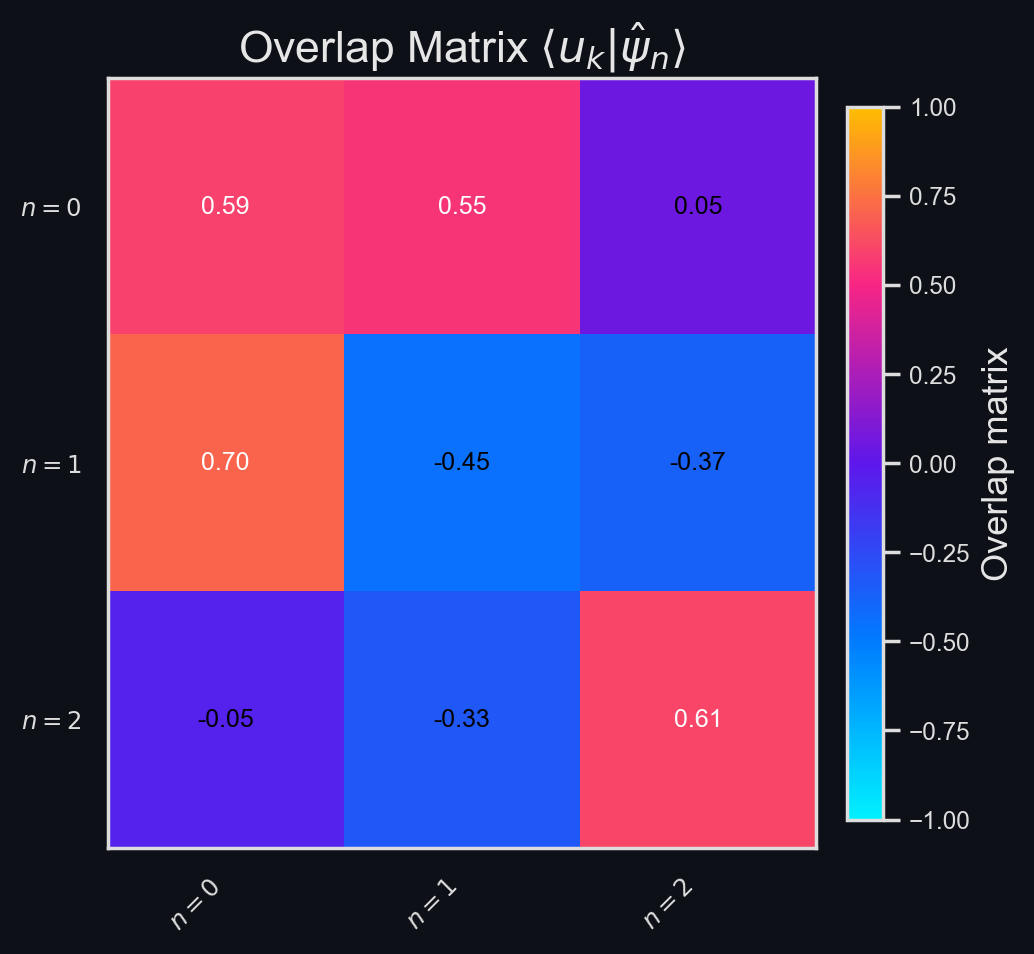
Figure 10 - POD Eigenfunction Alignment
- Choose different color scale for more intuitive visualization
- Change \(u_k\) in title and axis labels to \(\sigma_k\)
Take-Home Message
Heavy mode mixing between POD spatial modes and ground-truth eigenfunctions indicate imperfect physical recovery.
🔑 Key Insights
-
Diagonal attenuation: Overlap values along diagonals are
\[ \begin{align*} \langle \sigma_0 | \hat{\psi}_0 \rangle &= 0.82 \\ \\ \langle \sigma_1 | \hat{\psi}_1 \rangle &= 0.69 \\ \\ \langle \sigma_2 | \hat{\psi}_2 \rangle &= 0.20 \end{align*} \] -
Physical cross-talk: Substantial projection onto adjacent physical eigenstates (e.g., \(-0.44\) and \(+0.38\)).
❌ Failure Modes
| Verdict | Failure Mode | Description | Explanation |
|---|---|---|---|
| ❌ | Mis-alignment | Off-diagonal \(> 0.2\) or diagonal \(< 0.90\) indicates POD not yet physical. | Off-diagonals reache \(-0.44\) and diagonals drop to \(0.69\). |
Figure 11 - Temporal Modes
- Choose different color scale for more intuitive visualization.
- Rewrite Take-Home Message to reflect your own understanding of the figure. Current description is not clear and is a placeholder.
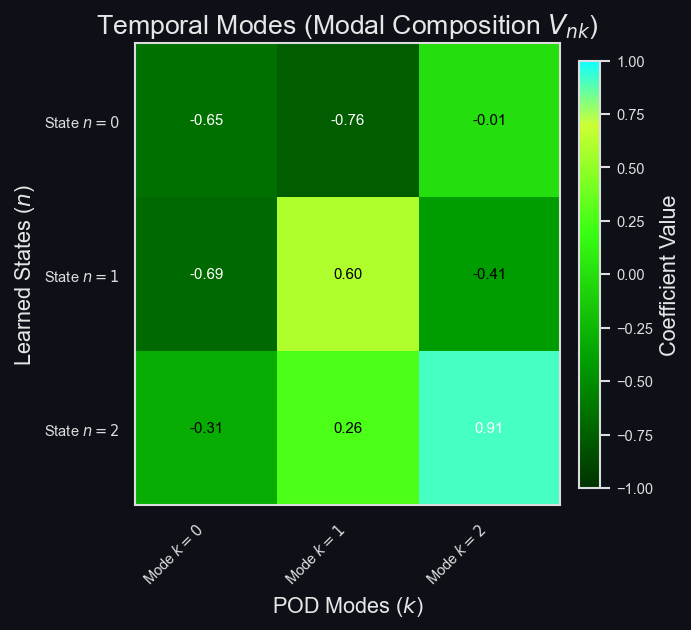
Take-Home Message
Right singular matrix components \(V_{nk}\) reflect modal participation of POD basis vectors across learned states.
🔑 Key Insights
-
Modal composition: State \(0\) draws from \(\sigma_0\) (\(-0.88\)), and \(\sigma_1\) (\(-0.47\)). State \(1\) draws from \(\sigma_0\) (\(-0.46\)) and \(\sigma_1\) (\(+0.87\)).
-
State doubling: State \(2\) is pre-dominantly aligned with \(\sigma_2\) (\(0.98\)).
❌ Failure Modes
| Verdict | Failure Mode | Description | Explanation |
|---|---|---|---|
| ❌ | Incoherent coefficients | Scatter if non-zero coefficients across temporal mode entries. | States \(0\) and \(1\) exhisbit multi-mode particiption rather than diagonal isolation. |
Figure 12 - Temporal overlap heatmap
- Choose different color scale for more intuitive visualization.
- Consider using a diverging color scale to highlight the diagonal structure.
- Adjust colorbar limits to better represent the range of values.
- Normalize color scale to emphasize diagonal structure.
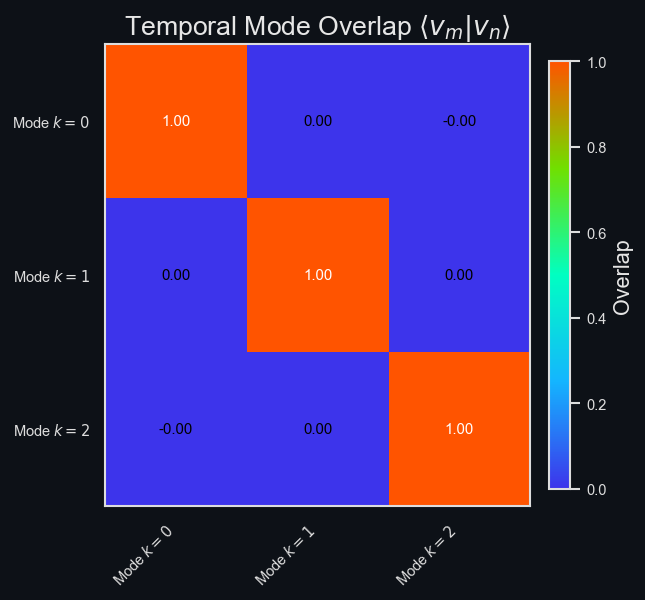
Take-Home Message
Orthogonality of right singular vectors \(\langle v_m | v_n \rangle\), conforms to exact unitary requirements.
🔑 Key Insights
-
Unitary property - Diagonals equal \(1.00\) and off-diagonals equal to \(\pm 0.00\).
-
SVD Consistency: - Confirms numerical precision of the underlying SVD algorithm
❌ Failure Modes
| Verdict | Failure Mode | Description | Explanation |
|---|---|---|---|
| ✔️ | Identity deviation | Off-diagonal deviation from standard identity. | Off-diagonals are identically \(0.00\), fully passing unitary criteria. |
Figure 13 - Overlap Matrix \(|\langle \mathbf{e}_n | v_n \rangle|\)
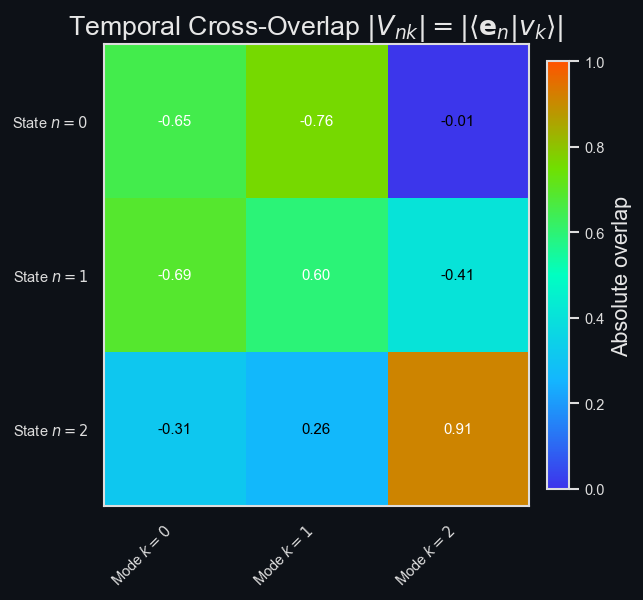
Take-Home Message
Absolute coefficients \(|V_{nk}| = |\langle \mathbf{e}_n | v_k \rangle|\) reveal modal mixing across snapshot states.
🔑 Key Insights
-
Cross-state sarticipation: Off-diagonal magnitudes reach \(0.47\) (\(n=0, \, k=1)\) and \(0.46\) (\(n=1, \, k=0)\).
-
Partial state isolation: State \(2\) maintains strong modal dominance with \(k=2\) (\(0.96\)).
❌ Failure Modes
| Verdict | Failure Mode | Description | Explanation |
|---|---|---|---|
| ❌ | Spread dominance | Multiple temporal modes project onto single state. | States \(0\) and \(1\) exhibit shared weight distribution across modes \(0\) and \(1\). |